Department Details
The Department of Respiratory and Critical Care Medicine at Zhongshan Hospital, Fudan University, originated from the Pulmonary Department founded in the 1930s by Professor Wu Shaoqing, a renowned Chinese pulmonologist and one of the founders of tuberculosis prevention and control in China. It was also the earliest established pulmonary disease research laboratory in the country. Professor Wu Shaoqing made pioneering contributions to tuberculosis prevention and treatment, as well as pulmonary function testing. Subsequently, Professor Li Huade conducted extensive groundbreaking work in the development, training, and promotion of pulmonary function equipment, the development of ventilators and blood gas analyzers, and the application of mechanical ventilation for respiratory failure treatment, establishing himself as one of the founders of modern respiratory medicine. Professors Jia Youming and Zhang Dunhua made leading contributions to the diagnostic application of bronchoscopic intervention and the operation and standardization of medical thoracoscopy. Professor Niu Shanfu achieved outstanding results in the application and promotion of non-invasive ventilation and the development of non-invasive masks. The use of non-invasive ventilation significantly improved the success rate of treating respiratory failure in COPD and reduced the rate of endotracheal intubation. Professor He Lixian conducted early and in-depth explorations into the pathogenesis, diagnosis, and treatment of pulmonary infections in immunocompromised hosts, achieving significant progress. Professor Bai Chunxue was the first to propose the concept of "Internet of Things (IoT) Medicine," leading the industry in the layout and connotation research of IoT medicine. In the diagnosis and treatment of small pulmonary nodules, he utilized artificial intelligence to assist in the early diagnosis of lung cancer, led the development of the Asia-Pacific guidelines for pulmonary nodule diagnosis and treatment, proposed the "Hundreds, Thousands, and Tens of Thousands" project through the China Lung Cancer Prevention and Treatment Alliance, and implemented a three-month single-specialty training program for pulmonary nodule diagnosis and treatment at the hospital to cultivate talent for the diagnosis and differential diagnosis of small pulmonary nodules.
The department was selected as a Shanghai Municipal Key Medical Discipline and a Shanghai Municipal Key Discipline in 2004 and 2007, respectively. In 2012, it was approved as a Shanghai "Top Priority" Clinical Key Discipline and was also selected as one of the first batch of National Key Clinical Specialty Construction Projects by the National Health and Family Planning Commission. In 2015, it was selected for the Shanghai Municipal Public Health Key Discipline Construction Project. In 2017, it was re-approved as a Shanghai "Top Priority" Clinical Key Discipline. In 2018, it was designated as a PCCM Construction Demonstration Unit by the Chinese Medical Doctor Association's Respiratory Physician Branch.
In 1997, the department collaborated with the Department of Thoracic Surgery at Zhongshan Hospital, the Department of Respiratory Medicine at Huashan Hospital, the Department of Respiratory Medicine at Children's Hospital, the Lung Cancer Group at the Cancer Hospital, and the Shanghai First Pulmonary Hospital to establish the Institute of Respiratory Diseases, Shanghai Medical College (formerly Shanghai Medical University). In 2012, it partnered with Huadong Hospital, Ruijin Hospital, and others to establish the Shanghai Institute of Respiratory Diseases. In 2021, it was approved to establish the Shanghai Key Laboratory of Pulmonary Inflammation and Injury and the Shanghai Respiratory IoT Medicine Research and Engineering Center. These platforms provide crucial support for advancing respiratory disease research in Shanghai, promoting the translation of scientific achievements, and cultivating outstanding respiratory talent.
The department also oversees the Shanghai Respiratory Medicine Clinical Quality Control Center, which has improved the standardized diagnosis and treatment level of respiratory diseases across the city.
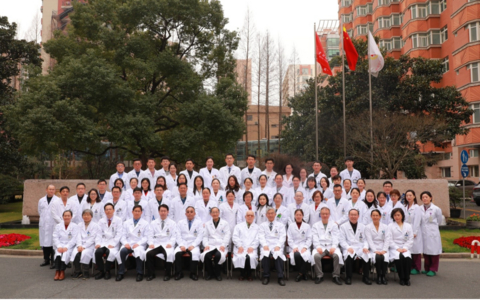
The department currently has 14 senior-level staff (Chief Physicians/Professors/Researchers, including 8 doctoral supervisors), 9 associate senior-level staff (Deputy Chief Physicians/Associate Professors), 24 attending physicians, 5 resident physicians, 4 researchers, and 12 technical staff. The department's vision is "Align with international standards, face the world, serve patients, and benefit society." Its development goals are: "Transform foundational construction into top-level design, transform academic following into academic leadership, transform practical innovations into international inventions, and transform 'Made in China' into 'Intelligent Creation'." It has cultivated an internationally recognized team meeting the "Double First-Class" requirements, characterized by "having a voice at international conferences, having influence in international journals, holding positions in international societies, and gaining recognition from the international community." It has pioneered IoT medicine and secured an international leading position in IoT medicine and pulmonary nodule diagnosis and treatment, demonstrating the advantages of "top-level design, academic leadership, technological innovation, and intelligent benefits for the public."
Furthermore, closely aligning with changes in disease patterns and the clinical needs of respiratory medicine in China, the department has formed five major subspecialties.
**1. Respiratory Critical Care:** Originating in the late 1950s, this subspecialty has published a series of monographs on mechanical ventilation and clinical pulmonary function. It is currently building an IoT-enabled eRICU (Respiratory Intensive Care Unit) and has implemented technologies such as Extracorporeal Membrane Oxygenation (ECMO), blood purification, prone position ventilation, protective lung ventilation, and Electrical Impedance Tomography (EIT). It was among the first in China to perform non-invasive positive pressure ventilation, protective mechanical ventilation, cardiopulmonary function monitoring, and research on alveolar fluid clearance and pulmonary edema treatment. The development of novel ventilation masks and improvements in treatment techniques have expanded the indications for non-invasive mechanical ventilation, which also played a positive role in COVID-19 treatment. Current research includes comprehensive diagnosis and treatment of severe pneumonia, clinical studies on stem cell therapy for ARDS, drug development for ARDS, and the construction of a clinical early warning platform.
**2. Chronic Airway Diseases:** Starting in the 1950s, based on research in pulmonary function and respiratory physiology, the department conducted training and quality control for pulmonary function testing, as well as diagnosis and management of chronic respiratory diseases. In 2000, it established Shanghai's first specialized asthma clinic, followed by East China's first specialized COPD clinic in 2002. In recent years, it proposed "Mobile phone-based Cloud+Terminal IoT Medicine," developed the world's first IoT PM2.5 spirometer, an IoT-assisted COPD management system, and an IoT-empowered asthma optimization management system. It led the development of the world's first consensus on AECOPD and established over 20 IoT medicine demonstration bases nationwide, playing a leading role in improving the level of homogenized hierarchical diagnosis and treatment. Current work includes IoT-based chronic disease management, wearable devices for diagnosing respiratory diseases, IoT-based home non-invasive ventilation, and respiratory rehabilitation.
**3. Lung Tumors and Interventional Pulmonology:** On January 28, 2002, the department established the nation's first Comprehensive Diagnosis and Treatment Center for Lung Tumors. In 2007, it established a targeted therapy clinic for lung cancer. In 2014, it proposed the top-level design of "moving the diagnostic port forward and sinking the focus downward" for lung cancer, led the development of the "Asia-Pacific Guidelines for the Evaluation of Pulmonary Nodules" and China's first consensus on "Diagnosis and Treatment of Pulmonary Nodules," marking the first time a Chinese respiratory society led the development of international guidelines. It developed the BaiDX IoT pulmonary nodule diagnostic system, laser confocal technology, and an IoT-assisted targeted therapy management system for lung cancer. It was among the earliest in China to use medical thoracoscopy for diagnosing pleural diseases. In 2012, it established the China Lung Cancer Prevention and Treatment Alliance, setting up sub-centers for pulmonary nodule diagnosis and treatment in 120 university hospitals and over 710 prefectural and county-level hospitals nationwide, and promoted the pulmonary nodule evaluation guidelines within the Asia Pacific Society of Respirology and in Sri Lanka.
**4. Pulmonary Infections:** This subspecialty focuses on microbial identification methods combining traditional microbiology and molecular diagnostics, clinical diagnosis and treatment of pulmonary infections, prevention and control of hospital-acquired infections, clinical and basic research on pulmonary infections in immunocompromised hosts, and molecular diagnosis of PJP bloodstream infections. It is responsible for developing guidance documents for the clinical management, prevention, and control of ventilator-associated pneumonia. It collaborates with enterprises to develop rapid pathogen diagnostic kits based on multiplex PCR, conducts clinical trials for severe pneumonia, and has accumulated experience in treating severe pneumonia using integrated Traditional Chinese and Western Medicine.
**5. Interstitial Lung Disease (ILD):** Building on the tradition of standardized diagnosis and treatment concepts for ILD, besides traditional diagnostic techniques like pulmonary function tests, bronchoscopic bronchoalveolar lavage, and transbronchial lung biopsy, the department actively implements diagnostic techniques such as cardiopulmonary exercise testing, six-minute walk distance, transbronchial cryobiopsy, and respiratory rehabilitation for ILD. It operates specialized clinics for ILD and Pulmonary Lymphangioleiomyomatosis (PLAM) and actively promotes the MDD (Multidisciplinary Discussion) model for ILD diagnosis and treatment. The department has participated in multiple international and domestic multi-center clinical studies on anti-fibrotic drugs. Current research includes AI-based quantitative imaging analysis for ILD, exploring novel pulmonary function indicators for diagnosing or monitoring ILD, and biomarkers based on the "induced sputum technology platform."
The department also houses a Sleep Laboratory, a Bronchoscopy Suite, and a Pulmonary Function Laboratory. The Bronchoscopy Suite is also a pilot unit of the National Health Commission for precision diagnosis and treatment of early lung cancer based on electromagnetic navigation systems. Currently, the department serves as the host unit for the China Lung Cancer Prevention and Treatment Alliance and the National Geriatric Medical Center's Alliance for the Prevention and Treatment of Pulmonary Infections and Respiratory Failure in the Elder

 English