Department Details
The Department of Urology at the First Affiliated Hospital of Guangzhou Medical University was established as an independent department in 1976. In 1984, it pioneered the development of minimally invasive urological techniques. Through the efforts of three generations of academic leaders, including Professors Wu Kaijun, Li Xun, and Zeng Guohua, it has developed into a National Key Clinical Specialty of the Ministry of Health, as well as a key specialty of Guangdong Province and Guangzhou City. It currently serves as the chair unit of the Urology Branch of the Guangdong Medical Association, the supporting unit of the International Alliance of Urolithiasis (IAU), the Guangdong Provincial Key Laboratory of Urology, the Guangzhou Institute of Urology, and the Department of Urology at Guangzhou Medical University. It is also a unit for master's and doctoral degree conferral and a postdoctoral research station, a training unit for the Endourology Fellowship program of the International Society of Endourology, one of the first training bases and examination centers for urological endoscopic diagnosis and treatment technology designated by the Ministry of Health, and the first base for etiological diagnosis, prevention, and treatment of urolithiasis under the Chinese Urological Association.
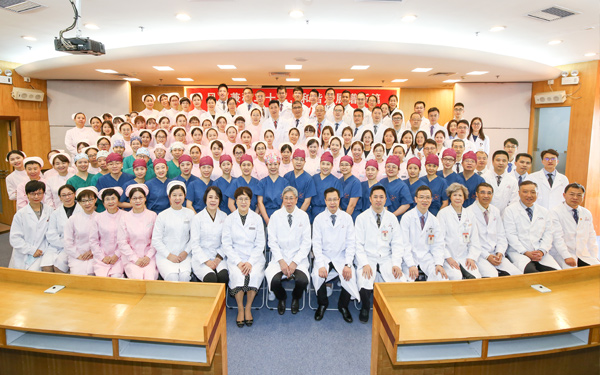
Currently, the Department of Urology has three clinical wards with 155 open beds. In the past three years, it has admitted nearly 7,000 urological patients annually and performed over 6,800 urological surgeries per year. The subspecialties currently established include urinary calculi, urogenital tumors, female pelvic floor disorders, prostate and urinary control, andrology, and reconstruction and repair. The department has 29 clinical physicians, including 12 with senior professional titles (professor level), 9 with associate senior titles, 18 with doctoral degrees, 16 with overseas experience, 7 doctoral supervisors, and 13 master's supervisors.
The research platform of the Department of Urology is the Guangdong Provincial Key Laboratory of Urology and the Guangzhou Institute of Urology. The main research areas include the detection and prevention of urinary stone etiology; metabolic abnormality testing and prevention; 24-hour urine metabolic risk factor analysis for stone formation; molecular biology research on prostate diseases; and the development and research of new endoscopic techniques for the urinary system. Established platforms include the Cell and Molecular Biology Research Platform, the siRNA Chemical Technology Platform, the Chinese Urinary Stone Information and Resource Database Platform, the Urinary Tumor Research Platform, and the Clinical Pharmacology Base Platform. From 2010 to 2020, the department undertook 190 research projects, including 31 national-level projects, 58 provincial-level projects, and 50 municipal-level projects. A total of 611 papers were published, including 269 SCI papers. 64 patents were applied for, including 3 international inventions, 9 Chinese invention patents, and 56 utility model patents. The department received 19 scientific and technological achievement awards, including 2 National Science and Technology Progress Second Prizes, 1 Chinese Medical Science and Technology Second Prize, 8 provincial/ministerial-level science and technology awards, 5 municipal-level science and technology awards, and 3 national and provincial multimedia education software competition awards. The department has edited 8 monographs (including 1 in English), co-edited 2, and contributed to 14 others (including 2 in English). Among these, *Percutaneous Nephrolithotomy* and *Flexible Ureteroscopy* are the first domestic monographs on related minimally invasive techniques and have become important reference books for urologists in China.
The training platform of the Department of Urology is the Minimally Invasive Technique Training Center, which is one of the first training bases and examination centers for urological endoscopic diagnosis and treatment technology designated by the Ministry of Health and a training unit for the Endourology Fellowship program of the International Society of Endourology. It has trained over 13,000 urologists from China and is known in the field as the "Whampoa Military Academy of Endourological Techniques." The training center covers an area of 1,500 square meters and is equipped with advanced simulation training models for endoscopic urological techniques, basic laparoscopic operation training models, percutaneous nephrolithotomy puncture simulation training models, flexible ureteroscopy simulation operation models, and an experimental animal operation training room. Simulation training for flexible ureteroscopic lithotripsy is conducted using 3D-printed kidneys and ureters. Real in vivo procedures, including ureteroscopic catheterization, flexible ureteroscopic lithotripsy, percutaneous nephrolithotomy, and laparoscopic surgery, are performed using experimental animals. The center enrolls trainees for six-month advanced study programs year-round. To date, it has organized 67 urology training courses and 208 continuing education programs at various levels, including specialized training courses on super-mini percutaneous nephrolithotomy, flexible ureteroscopy, and ureteral stricture balloon dilation, providing a broad learning platform for urologists in China. Additionally, it has held 11 international training courses, training 165 urologists from 40 countries, including the United States, the United Kingdom, Germany, Australia, Spain, Italy, and Austria. It has pioneered large-scale, routine minimally invasive technique training for international urologists and has been invited to perform 30 live surgical demonstrations in 18 countries.
**Department Honors:**
1. National Key Clinical Specialty of the Ministry of Health; Key Specialty of Guangdong Province and Guangzhou City.
2. Chair unit of the Urology Branch of the Guangdong Medical Association; Supporting unit of the International Alliance of Urolithiasis (IAU); Supporting unit of the Guangdong Provincial Key Laboratory of Urology, the Guangzhou Institute of Urology, and the Department of Urology at Guangzhou Medical University.
3. Unit for master's and doctoral degree conferral and a postdoctoral research station.
4. Training unit for the Endourology Fellowship program of the International Society of Endourology; One of the first training bases and examination centers for urological endoscopic diagnosis and treatment technology designated by the Ministry of Health.
5. The first base for etiological diagnosis, prevention, and treatment of urolithiasis under the Chinese Urological Association.

 English