Department Details
I. Discipline Development History
The Department of Hematology at Nanfang Hospital, Southern Medical University (formerly the First Military Medical University), was established in the 1970s, making it one of the earliest specialized hematology departments in China. Through continuous efforts across generations, it became a master's degree and doctoral degree authorization discipline in 1993 and 1996, respectively. It has gradually developed and expanded into a postdoctoral research station, a National Key Clinical Specialty, a National Clinical Trial Base for New Hematological Drugs, a National Specialist Physician Training Base, a former Military Blood Disease Center, a Guangdong Provincial Key Specialty for Hematological Diseases, a Key Discipline for Hematological Diseases under the Guangdong Provincial Department of Education, a Guangdong Provincial Hematological Disease Medical Quality Control Center, a Guangdong Provincial Hemophilia Diagnosis and Treatment Management Center, a World Federation of Hemophilia (WFH) China Hemophilia Diagnosis and Treatment Training Center, and a collection and transplantation hospital for the China Marrow Donor Program and the Taiwan Buddhist Tzu Chi Stem Cells Center. In response to disciplinary development needs, the Institute of Hematology, Southern Medical University, was established in 2011. It holds a leading and advanced position nationally in the precise diagnosis and treatment of leukemia, targeted therapy for lymphoma/multiple myeloma, hematopoietic stem cell transplantation and complication management, and comprehensive hemophilia care.
II. Discipline Structure
The Institute of Hematology, Southern Medical University, is the permanent institution. The discipline currently comprises four components: the General Diagnosis and Treatment Ward, the Hematopoietic Stem Cell Transplantation Ward, the Huiqiao Building Ward, and the Key Laboratory of Hematology, Southern Medical University. The General Diagnosis and Treatment Ward has 102 beds, the Hematopoietic Stem Cell Transplantation Ward has 34 beds, and the Huiqiao Building Ward has 16 beds. The Hematology Laboratory covers a practical area of 500 m² and includes sub-laboratories for Immunology, Cytogenetics, Molecular Biology, Cell Morphology, and a Leukemia Sample and Data Database.
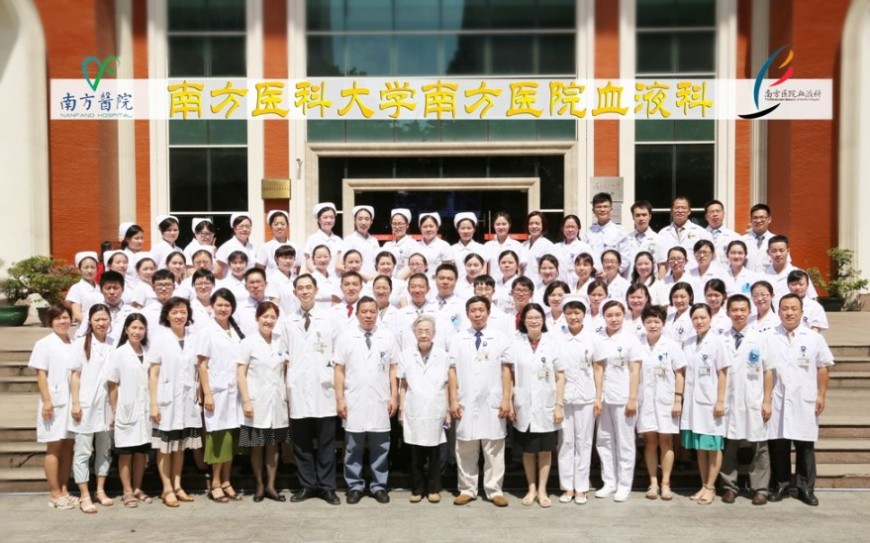
Personnel: The department has a total of 140 medical, technical, and nursing staff, including 34 physicians (13 with senior professional titles), 14 technical staff, and 91 nurses. All physicians hold a master's degree or higher, and 13 have overseas study experience. There are 4 doctoral supervisors and 5 master's supervisors. Faculty members hold positions including 2 vice chairpersons and 5 standing committee members in national-level societies, and 4 chairpersons and 5 vice chairpersons in provincial-level societies.
III. Medical Features
1. Precise Diagnosis and Treatment of Leukemia
Leukemia is a common hematologic malignancy. Treatment regimens and outcomes vary significantly by type, with the current international trend being precise, individualized therapy. Since the 1990s, the Department of Hematology at Nanfang Hospital has implemented precision medicine for leukemia, including: Precise Diagnosis – employing advanced techniques such as morphology, immunology, genetics, and gene mutation detection for accurate diagnosis, classification, risk stratification, and identification of therapeutic targets for each leukemia patient; Individualized Treatment – based on the patient's precise diagnosis, prognostic stratification, and target selection information, we tailor individualized treatment plans involving chemotherapy, radiotherapy, targeted therapy, and transplantation.
Through precision medicine, our department currently achieves a high complete remission rate for induction therapy in acute leukemia. The use of all-trans retinoic acid combined with arsenic trioxide for acute promyelocytic leukemia results in a high 5-year disease-free survival rate. High-dose cytarabine consolidation followed by sequential autologous hematopoietic stem cell transplantation for good-risk acute non-lymphocytic leukemia yields a long-term disease-free survival rate of 80%. Allogeneic hematopoietic stem cell transplantation for intermediate/high-risk acute lymphoblastic and non-lymphoblastic leukemia achieves a 5-year disease-free survival rate of 70%. "Gene quantification" combined with "mutation detection" to guide treatment for chronic myeloid leukemia results in a high 5-year disease-free survival rate. A strategy of intensified conditioning allogeneic hematopoietic stem cell transplantation combined with early tapering of immunosuppressants and donor lymphocyte infusion for refractory/relapsed leukemia achieves a 5-year disease-free survival rate exceeding 50%.
2. Targeted Therapy for Lymphoma/Multiple Myeloma
Lymphoma/multiple myeloma is a key subspecialty direction supported and developed by our department. We have established a precise diagnostic and stratification system for lymphoma/multiple myeloma using comprehensive techniques including histopathology, immunohistochemistry, fluorescence in situ hybridization (FISH), immunophenotyping of lymph node cell suspensions (flow cytometry), karyotype analysis, MRI, PET-CT, and next-generation sequencing. We implement stratified, individualized, and targeted therapy for patients with lymphoma and multiple myeloma through chemotherapy, targeted therapy, hematopoietic stem cell transplantation, radiotherapy, and clinical trials of new drugs. Considering the disease characteristics, we have assembled a multidisciplinary team (MDT) involving relevant departments at Nanfang Hospital to provide patients with more comprehensive, rapid, and professional multi-dimensional diagnosis and treatment.
We employ immunochemotherapy for patients with diffuse large B-cell lymphoma, follicular lymphoma, chronic lymphocytic leukemia, and other lymphomas. We pioneered clinical research on bendamustine for indolent B-cell lymphomas like chronic lymphocytic leukemia. For high-risk/refractory/relapsed lymphoblastic lymphoma and NK/T-cell lymphoma, we use allogeneic hematopoietic stem cell transplantation, achieving a 3-year disease-free survival rate of 60%. We have introduced new drugs like the proteasome inhibitor bortezomib and lenalidomide for treating multiple myeloma in China, significantly improving efficacy and patient quality of life. In summary, through our precise diagnosis and individualized targeted therapy system, our department holds a leading position nationally in the comprehensive diagnosis and treatment of lymphoma/multiple myeloma.
3. Hematopoietic Stem Cell Transplantation and Complication Management
Our department is one of the earliest units in China to perform hematopoietic stem cell transplantation and is currently a major transplantation center in South China with a high volume of transplant cases. From the first transplant in 1984 to 2015, we have completed nearly 2000 transplants. We currently have 31 laminar airflow transplant beds, capable of performing all types of hematopoietic stem cell transplantation, with over 250 transplants performed annually.
Key processes in hematopoietic stem cell transplantation include donor selection, timing and type of transplant, optimization of conditioning regimens, and management of post-transplant complications. Our department has established mature techniques for unrelated donor and haploidentical (related half-matched) donor transplantation, achieving outcomes comparable to matched sibling donor transplantation, thus solving the donor source problem. We select transplant timing and type based on precise diagnosis. Using an etoposide-enhanced conditioning regimen for high-risk/refractory acute lymphoblastic leukemia patients achieves a 3-year disease-free survival rate of up to 70%. Using an intensified conditioning regimen combined with donor lymphocyte infusion for refractory leukemia/lymphoma achieves a 5-year survival rate of 60%. We have accumulated extensive experience in managing transplant complications and established mature and systematic diagnostic and treatment protocols. We hold a leading national position in areas such as the prevention and treatment system for post-transplant viral infections, the diagnosis and treatment system for post-transplant lymphoproliferative disorder (PTLD), the use of CD25 monoclonal antibody combined with mesenchymal stem cells (MSC) for refractory graft-versus-host disease (GVHD), and the early diagnosis and intervention of non-infectious pulmonary complications. Additionally, our department maintains a high level of expertise in CD34-purified autologous hematopoietic stem cell transplantation for refractory/relapsed systemic lupus erythematosus and refractory/relapsed pemphigus.
4. Comprehensive Hemophilia Care
Our hospital is one of the earliest units in China to provide comprehensive hemophilia diagnosis and treatment. The Nanfang Hospital Hemophilia Center established a "WFH Hemophilia Sister Center" with the CHEO Hospital in Ottawa, Canada, in 2000. It was approved as the "Guangzhou Hemophilia Treatment Center" by the World Federation of Hemophilia (WFH) in 2001. It was designated as the "Guangdong Provincial Hemophilia Diagnosis and Treatment Center" by the Chinese Medical Association's Hematology Branch in 2009. It was approved as the "Guangdong Provincial Hemophilia Case Information Management Center" by the Guangdong Provincial Health Department in January 2010. It was recognized as the "WFH China Hemophilia Diagnosis and Treatment Training Center" by the WFH in November 2010. It was approved as the "Guangdong Provincial Hemophilia Diagnosis and Treatment Management Center" by the Guangdong Provincial Health and Family Planning Commission in 2013. By establishing a multidisciplinary comprehensive team and providing domestic and international training for key medical and nursing staff, our department has built a complete comprehensive care system, currently following over 1500 patients from within and outside the province. The center operates a specialized hemophilia outpatient clinic, implements comprehensive hemophilia nursing care, with dedicated hemophilia nurses running nursing clinics on Mondays, Wednesdays, and Fridays to train patients in self-injection and self-care knowledge and skills. We organize Sunshine Club activities, hold regular social events on World Hemophilia Day (April 17th) annually, providing a platform for experience exchange between doctors and patients, and among patients themselves. We have established a comprehensive patient registration and follow-up management system. We have dedicated hemophilia physiatrists and therapists to assist in guiding joint exercises and rehabilitation. We regularly hold patient education sessions on hemophilia knowledge and new developments in diagnosis and treatment, providing free educational materials, treatment aids, and training for home therapy and self-injection. A multidisciplinary team of experts assists in managing complex hemophilia complications, such as genetic diagnosis, prenatal diagnosis, major surgeries, inhibitor

 English