 English





.png)
With the 140th Canton Fair approaching, Middle Eastern exhibitors are reminded to pay attention to the high prevalence of hidden hyperglycemia in the MENA region. Fasting blood glucose + HbA1c screening is recommended for early cardiovascular risk prevention, and DOVECURE provides full-process bilingual medical accompanying services.
Before a Heart Incident, Blood Sugar May Have Been Sending Alarms for Years — International Merchants Attending the Canton Fair Should Not Skip Glycated Hemoglobin Screening
With the 140th Canton Fair approaching in Guangzhou this October, tens of thousands of Middle Eastern exhibitors will soon arrive in Pazhou. Their schedules are packed with booth setup, sample preparation, negotiations, and business dinners — but one critical item is likely missing from their itineraries: a blood sugar check.
Diabetes in the MENA Region: No Longer a Slow, Gradual Rise
Diabetes is far from a new concern in the Middle East and North Africa, but its growth trajectory has reached alarming levels. Data from the International Diabetes Federation (IDF) Diabetes Atlas shows that the number of adults aged 20–79 living with diabetes in Egypt surged from 3.4 million in 2000 to 13.2 million in 2024, and is projected to hit 24.7 million by 2050. Egypt currently has an age-standardized diabetes prevalence of 22.4%, ranking 10th globally, with an estimated rise to 9th place by 2045. Most notably, approximately 62% of people with diabetes in Egypt remain undiagnosed — meaning more than 8 million adults are unaware they have the condition.
The situation in Morocco is equally concerning. IDF figures indicate that the number of adults living with diabetes in Morocco rose from roughly 385,000 in 2000 to 2.88 million in 2024, marking a more than sixfold increase. The age-standardized prevalence climbed from 6.8% in 2011 to 11.9% in 2024, representing a 75% surge over 13 years. Morocco records around 40,000 new diabetes cases annually, and diabetes-related deaths account for 10.9% of all fatalities in the country.
This is not an isolated trend in a single nation, but a systemic pattern across the entire region. A GBD time-trend analysis covering 21 MENA countries found that between 1990 and 2023, the age-standardized incidence of diabetes in the region rose by 92%, with prevalence doubling from 5,564 cases per 100,000 people to 11,247. The MENA region now has the highest age-adjusted diabetes prevalence in the world, at 19.9%.
Multiple interconnected factors are driving this rapid growth. A review published in Nature Reviews Endocrinology notes that declining diet quality, insufficient physical activity, genetic predisposition, obesogenic food environments, and combined socioeconomic and cultural factors have collectively fueled the diabetes epidemic across the region. North African countries are undergoing a rapid phase of nutritional transition, with increases in high body mass index and elevated fasting blood sugar ranking among the steepest globally.
The Real Danger of Diabetes Lies Beyond Blood Sugar Levels
If diabetes were simply a matter of "slightly high blood sugar," it would not be one of the most worrying non-communicable diseases in the Middle East. The core risk lies in the systemic damage that sustained high blood sugar inflicts on the vascular system.
The epidemiological link between diabetes and cardiovascular disease is well established. Data from a 15-year follow-up cohort study in the Middle East shows that people with diabetes have a cardiovascular event annual incidence rate of 13.77 per 1,000 people, and a cardiovascular event mortality rate of 3.01 per 1,000 people. Among this population, the prevalence of coexisting hypertension and dyslipidemia reaches 71% and 92% respectively.
From a pathological perspective, long-term high blood sugar damages the cardiovascular system through multiple pathways. A hyperglycemic environment injures vascular endothelial cells, promoting the formation of atherosclerotic plaques; it also disrupts clotting factor and platelet function, putting the blood in a hypercoagulable state that makes thrombus formation — and subsequent myocardial ischemia — far more likely. Diabetic cardiomyopathy is driven by a combination of epicardial atherosclerosis, hypertension, microvascular lesions, endothelial dysfunction, and autonomic impairment, significantly increasing the risk of heart failure after a myocardial infarction.
Findings from China’s Da Qing Diabetes Prevention Study, which followed participants for 34 years, offer a clear reference point: the earlier diabetes develops, the higher the long-term risk of cardiovascular events. Among participants with diabetes duration of no more than 20 years, the incidence rate of cardiovascular events in the early-onset group was 45.47 per 1,000 person-years, compared with 18.05 per 1,000 person-years in the late-onset group. This underscores that earlier detection and intervention substantially reduce the cumulative cardiovascular risk over time.
A Single Blood Draw, Two Key Markers for Basic Screening
For Middle Eastern business professionals exhibiting in Guangzhou, accessing diabetes screening is remarkably convenient.
The two core recommended tests are fasting plasma glucose (FPG) and glycated hemoglobin (HbA1c). Fasting plasma glucose reflects blood sugar levels at the moment of collection, requiring 8–12 hours of fasting beforehand. However, a single fasting glucose test has limitations: it can be affected by the previous day’s diet or stress, and cannot reflect long-term blood sugar control. Glycated hemoglobin works differently: it provides an average measure of blood sugar levels over the past 2–3 months, and is not influenced by a single meal or temporary physical activity.
The two tests complement each other. Fasting plasma glucose captures immediate blood sugar abnormalities, while HbA1c identifies cases where fasting glucose readings appear normal but long-term blood sugar levels remain elevated. Studies show that adding HbA1c screening to routine fasting glucose checks detects a significantly higher number of people with abnormal glucose metabolism, improving overall screening sensitivity. The International Diabetes Federation recommends using HbA1c ≥6.5% as one of the diagnostic thresholds for diabetes, while readings between 5.7% and 6.4% indicate prediabetes.
In Guangzhou, the time cost of completing both tests is extremely low. Hospitals equipped with metabolic disease management centers offer one-stop, rapid testing for blood glucose and HbA1c. For busy exhibitors, it is possible to complete the blood draw during a free morning window, with partial results available the same afternoon — creating no conflict with their exhibition schedules.
Leave This Process to DOVECURE in Guangzhou
If this is your first time exhibiting in Guangzhou, or you have visited before but have never used China’s healthcare system independently, arranging screening on your own can present practical barriers: you may not know which hospitals offer English-language services, be unfamiliar with the appointment process, or struggle to understand medical reports.
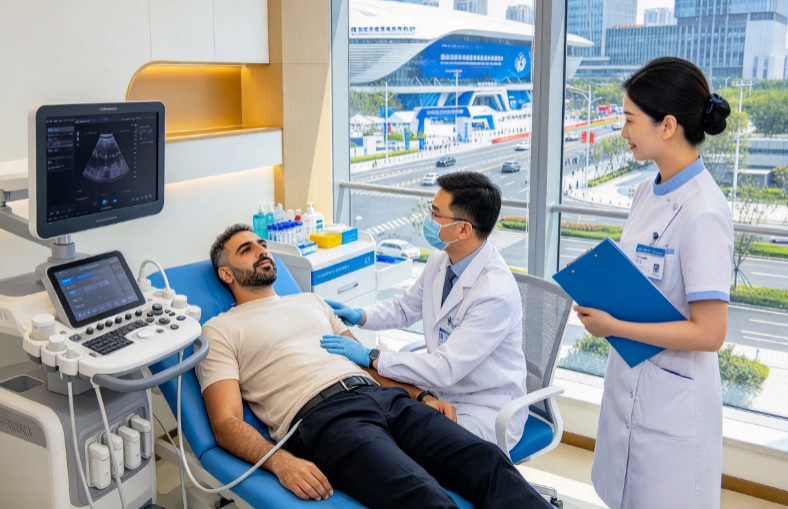
The DOVECURE medical companion platform is designed specifically to address these needs. For Middle Eastern business professionals attending the Canton Fair, DOVECURE provides full-process support from appointment booking, to bilingual medical companionship, to professional medical report translation. All you need to do is share your exhibition schedule and available free time, and DOVECURE’s team will help you book an appropriate hospital and testing slot, arrange a bilingual companion to guide you through every step including registration, payment, and blood collection. Once testing is complete, all medical reports are translated into Arabic or English, ensuring you fully understand the meaning of every indicator.
If results suggest further consultation or follow-up review is needed, DOVECURE can also assist with arranging subsequent specialist appointments. Beyond medical services, the platform’s full-service ecosystem covers visa support, airport transfers, and hotel booking. For visitors who wish to experience Guangzhou’s city life alongside their exhibition commitments, DOVECURE also offers customized high-end cultural tours and traditional Chinese medicine wellness experiences.
Every minute at the Canton Fair carries the potential for new orders and partnerships. But checking your blood sugar deserves half a day of your attention, even in the busiest schedule. A simple fasting glucose and HbA1c test may not change the outcome of your business trip this time — but it can give you new, clear insight into your long-term health status. That insight may prove to be more valuable than any single business deal.


压缩.png)

.png)