تفاصيل القسم
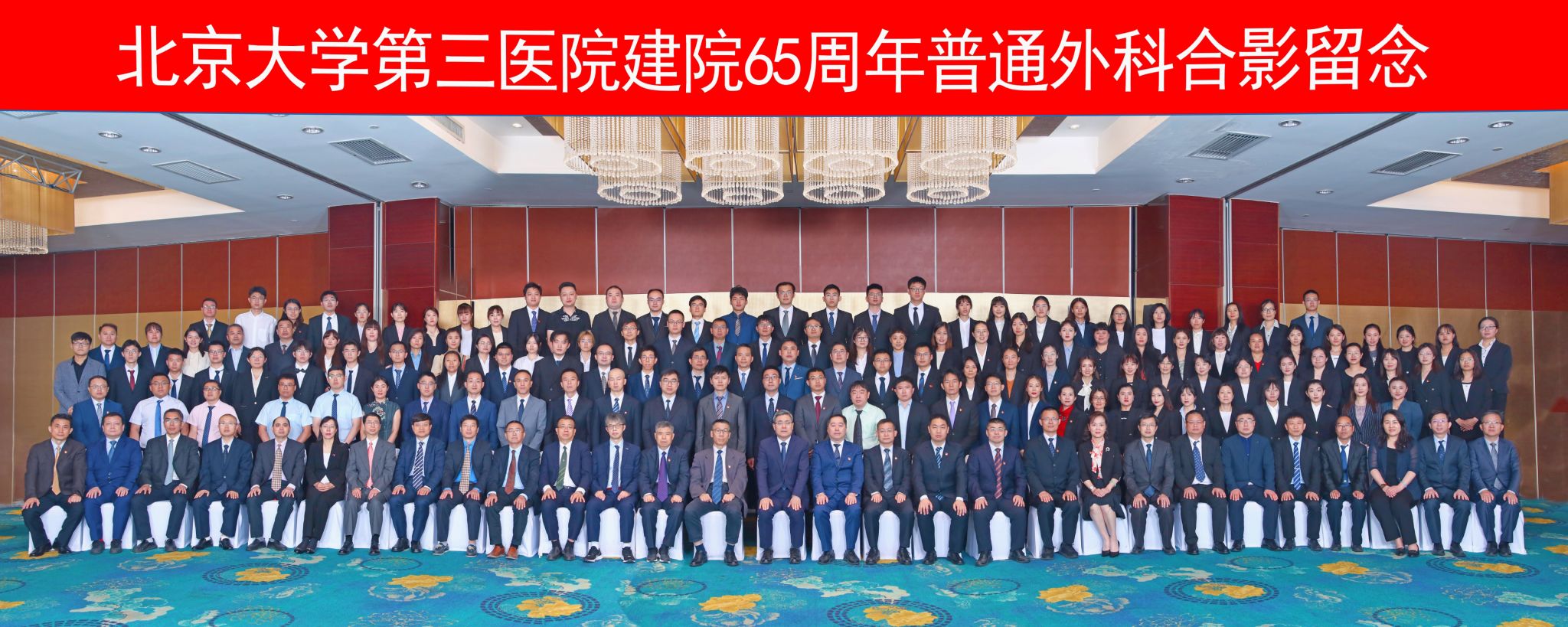
The Department of General Surgery at Peking University Third Hospital originated from the Department of Surgery Teaching and Research Section of the Third Affiliated Hospital of Beijing Medical College, established in 1958, with Zhang Wanhua serving as the head of general surgery. In the early 1980s, General Surgery became an independent department, with Professor Zhang Wanhua as its first director. In the early 1990s, General Surgery was divided into several relatively fixed specialty groups: biliary tract group, liver-pancreas group, gastrointestinal group, vascular group, and portal hypertension group. In 1991, the Department of General Surgery established a laparoscopic specialty group, in 1994 a laparoscopic training center was established, in 1999 a colorectal disease specialty group was established, in 2003 a breast disease specialty group was established, in 2007 a Digestive Disease Center was established in collaboration with the Department of Gastroenterology and the Cancer Treatment Center, and in 2008 the first national training base for minimally invasive hernia surgery was established. In 2012, it was rated as one of the first batch of National Key Clinical Specialties. In 2019, the Hernia and Abdominal Wall Surgery Center was established. The current department director is Professor Yuan Chunhui. The department has 27 experts at or above the associate professor level, with multiple subspecialty groups including liver, pancreas, biliary tract, gastrointestinal, thyroid/breast, and colorectal, with 196 beds.
I. Current Status of General Surgery
1. Department Party and Administrative Leadership: The Director of General Surgery is Professor Yuan Chunhui (serving as Director of General Surgery since 2022, with overall responsibility for the medical, teaching, and research work of General Surgery). The Deputy Director in charge of teaching is Associate Chief Physician Ma Chaolai, the Deputy Director in charge of research is Chief Physician Sun Tao, and the Deputy Director in charge of clinical affairs is Associate Chief Physician Wang Xingyan. Since 2014, Chief Physician Yuan Chunhui has served as the Party Branch Secretary of General Surgery.
2. Organizational Framework: General Surgery is currently divided into the Pancreatic Surgery Group, Gastrointestinal Surgery Group, Biliary Tract Surgery Group, Liver and Transplant Surgery Group, Breast Surgery Group, and Colorectal Surgery Group. There are three wards at the main campus. From 2008 to 2012, the main department of General Surgery operated three wards on floors 7-9 of the Surgical Building, with the 9th floor shared with the Department of Urology (10 urology beds). In 2012, the Second Ward Area of the Surgical Building was opened, and the original Surgical Building was renamed the First Ward Area of the Surgical Building. The Third Ward of General Surgery was relocated to the 8th floor of the Second Ward Area of the Surgical Building, corresponding to the Second Ward of General Surgery. The Third Ward of General Surgery expanded to occupy the entire ward and was no longer shared with Urology. The First Ward of General Surgery primarily admits patients with gastrointestinal diseases and breast diseases; the Second Ward primarily admits patients with pancreatic, liver, transplant, and portal hypertension conditions, and also includes a fast-track recovery ward admitting patients with appendicitis, hernia, gallbladder, and thyroid diseases; the Third Ward primarily admits patients with cholelithiasis and biliary tract tumors, and also includes a fast-track recovery ward. The Fourth Ward of General Surgery primarily admits patients with colorectal diseases, with Chief Physician Chen Chaowen responsible for the daily operations of the colorectal ward, currently located at the Central Party School Campus of Peking University Third Hospital, with 16 open beds.
3. Personnel Structure: General Surgery boasts renowned senior experts such as Zhou Xiaosi, Zhang Zishun, and Lu Shaomei, as well as a group of vigorous academic leaders and key personnel including Xiu Dianrong, Xu Zhi, and Fu Wei. The Department of General Surgery at Peking University Third Hospital is a doctoral degree-granting site, currently with 4 doctoral supervisors, 5 master's supervisors, and 27 experts at or above the associate professor level. General Surgery currently has 40 physicians, of whom 62.5% hold senior professional titles, 15% hold intermediate titles, and 22.5% hold junior titles; 95% have graduate degrees or above, with 78.5% holding doctoral degrees.
II. History of General Surgery
1. 60 Years of Development: In 1955, construction planning for the Third Affiliated Hospital of Beijing Medical College began, with the preparatory work for surgery handled by the then Department of General Surgery Teaching and Research Section. Construction of the hospital broke ground in 1957, and in the summer of 1958, the Third Hospital and its Surgery Teaching and Research Section were established. The Director of Surgery was Associate Professor Yang Keqin, with Deputy Director Dr. Deng Zongdai, and the head of general surgery was Attending Physician Zhang Wanhua. During the Cultural Revolution, the military propaganda team and workers' propaganda team merged Surgery, Plastic Surgery, and Sports Medicine into the Second Company, with Dang Gengting as company commander and Zhou Guanhan and Rui Jing'an as deputy commanders. In the late Cultural Revolution period, the pre-Cultural Revolution departmental structure was restored, with the Director of Surgery concurrently held by Zhu Hongyin (Director of Plastic Surgery), and six deputy directors: Yang Keqin, Zhang Wanhua, Dang Gengting, Zhou Guanhan, Rui Jing'an, and Wang Suzhen.
In the early 1980s, each surgical specialty group became an independent department with separately appointed directors and deputy directors. After General Surgery became independent, Professor Zhang Wanhua served as its first director. In August 1990, the Zhongzhilou Building was completed, and the internal medicine departments moved to the new building. From that time, General Surgery's bed capacity expanded from 60 to 95 beds, and later to 103 beds. In December 2005, all surgical departments moved into the new Surgical Building, and General Surgery's bed capacity increased to 123 beds (including 13 colorectal surgery beds).
In the early 1990s, General Surgery was divided into several relatively fixed specialty groups: biliary tract group, liver-pancreas group, gastrointestinal group, vascular group, and portal hypertension group. In 1991, the laparoscopic specialty group was established. In 1994, the Laparoscopic Training Center was established. In 1997, due to various reasons, the Laparoscopic Center was dissolved. In 1999, the colorectal disease specialty group moved to the Second Outpatient Department of Peking University Third Hospital, and later relocated to the Northern Hospital. In 2003, the breast disease specialty group was established. In 2003, Vascular Surgery became an independent department.
Over the past decade, the influence of General Surgery has continued to expand, and it is recognized nationally as a center for minimally invasive surgery and complex disease diagnosis and treatment. In recent years, General Surgery has successfully diagnosed and treated many patients with complex, critical, and rare diseases, such as acute severe cholangitis, gastrointestinal bleeding, colorectal cancer with liver metastases, and liver and pancreatic tumors, saving patients' lives and improving their quality of life. In 2008, it was designated by the Ministry of Health as a training base for general surgery endoscopic techniques, and regularly hosts four national continuing education programs annually, including the "National Advanced Laparoscopic Surgery Training Course," as well as two 3-month advanced laparoscopic training sessions each year, training nearly a thousand participants from across the country annually. In 2012, it was selected as a National Key Clinical Specialty (General Surgery).
2. Talent Development: Throughout its development, General Surgery has placed particular emphasis on team building and young physician training. At the hospital's founding, General Surgery had only 2 attending physicians and no senior-title personnel. Now, General Surgery has formed a distinct talent echelon. Among them, Xiu Dianrong is a member of the Liver Surgery Group of the Chinese Medical Association Surgery Branch, Xu Zhi is a member of the Biliary Tract Surgery Group of the Chinese Medical Association Surgery Branch, Professor Fu Wei is a member of the Experimental Surgery Group of the Chinese Medical Association, Yuan Chunhui is a member of the Pancreatic Surgery Group of the Chinese Medical Association Surgery Branch, and Yao Hongwei (transferred in 2016) was a member of the Colorectal Surgery Group of the Chinese Medical Association Surgery Branch. This fully demonstrates the overall academic level of General Surgery. The mid-level talent pool of General Surgery is robust, with more than 10 individuals including Ma Chaolai, Sun Tao, and Wang Gang holding positions in multiple national and provincial/municipal academic societies. General Surgery also values the training of young physicians, with physicians such as Zhang Zhipeng, Zhang Lingfu, and Wang Xingyan serving as young backbone personnel, strengthening their clinical training and research development while excellently completing teaching tasks. General Surgery also has multiple young physicians with doctoral degrees, ensuring an ample reserve of talent.
In addition, General Surgery currently has 51 nurses, with 74.4% holding college degrees or above. They have participated in the writing of multiple nursing textbooks and the recording of standardized procedure videos including nasogastric tube placement, drainage bag replacement, abdominal bandage application, and artificial anus care. By the end of 2007, the nursing team had produced 2 Beijing Outstanding Nurses, 1 Outstanding Head Nurse from Peking University Health Science Center, 7 Outstanding Nurses from Peking University Health Science Center, and 3 Outstanding Teachers at the university level from Peking University Health Science Center.
3. Innovative Work: General Surgery places great emphasis on innovative work. In clinical practice

 العربية