 English




People's Daily: "Chinese doctors' medical skills are absolutely superb" — British engineer makes two special trips to Wuhan for medical care in three years
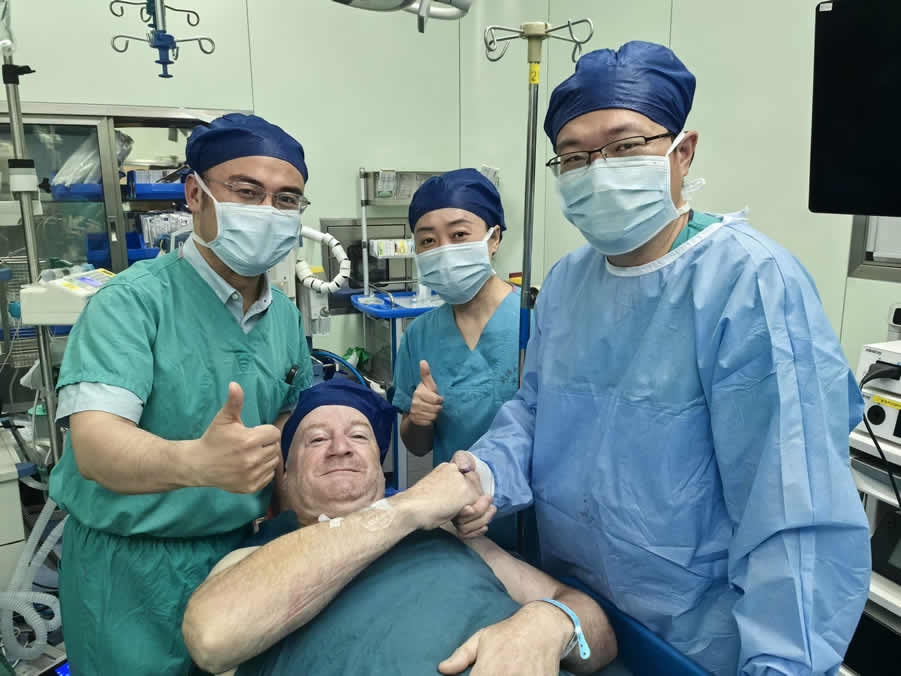
On May 11, British national Dean Johnson felt the pain in his waist and left leg disappear right after waking up from surgery in Wuhan. Overwhelmed with excitement, he gave a thumbs-up and exclaimed repeatedly: "Chinese doctors have solved the problem that British doctors could not! I will recommend Chinese doctors to all my friends when I go back!"
57-year-old Dean Johnson is an engineer. This marks his second trip to Wuhan for medical treatment, with his first visit dating back to 2023 when he sought relief from persistent back pain.
Dean Johnson told reporters from Changjiang Daily that he was caught in a severe car accident in 2008. Since then, he had suffered from chronic body pain, which he could only ease by practicing Pilates. In 2021, his back pain worsened drastically, to the point that even breathing became painful. "I visited many hospitals in the UK, underwent CT scans, MRIs and other examinations. The doctors diagnosed it as nerve damage and told me surgery was impossible. I tried pain management treatments, but none of them worked well," Johnson recalled.
In 2023, Dean Johnson got acquainted with several Chinese international students at work and asked them to recommend reliable Chinese doctors. In September that year, he heard that Professor Jia Yifan, director of the Pain Department at Renmin Hospital of Wuhan University, might have a solution for his condition. He immediately asked for leave and flew all the way from the UK to Wuhan for treatment. During that visit, Professor Jia and his team performed a radiofrequency combined with silver needle soft tissue release surgery on him.
The outcome exceeded all his expectations. Dean Johnson excitedly recalled to reporters: "He used just one single needle, and the pain was completely gone! After that treatment, my back never ached again!"
Dean Johnson added Professor Jia on WeChat. After Johnson returned to the UK, he often received messages from Professor Jia checking on his recovery progress, a gesture that deeply touched him.
This time, when Johnson's waist pain flared up, he reached out to Professor Jia again. On the morning of May 8, Dean Johnson flew to Wuhan. That afternoon, Associate Chief Physician Li Shenghong from Professor Jia's team received him. After reviewing the MRI images Johnson brought with him, the team confirmed that his pain was not neuropathic pain caused by nerve damage. To completely resolve the issue, a lumbar endoscopic surgery was required.
"Can't we use the needle treatment like last time?" Johnson asked, expressing concerns about potential surgical trauma.
Professor Jia explained: "The last treatment was radiofrequency therapy using a radiofrequency needle, which is actually a minimally invasive procedure. This time, the location and cause of your pain are completely different, so the treatment approach has to be adjusted accordingly. But this surgery is also minimally invasive and will not cause major trauma."
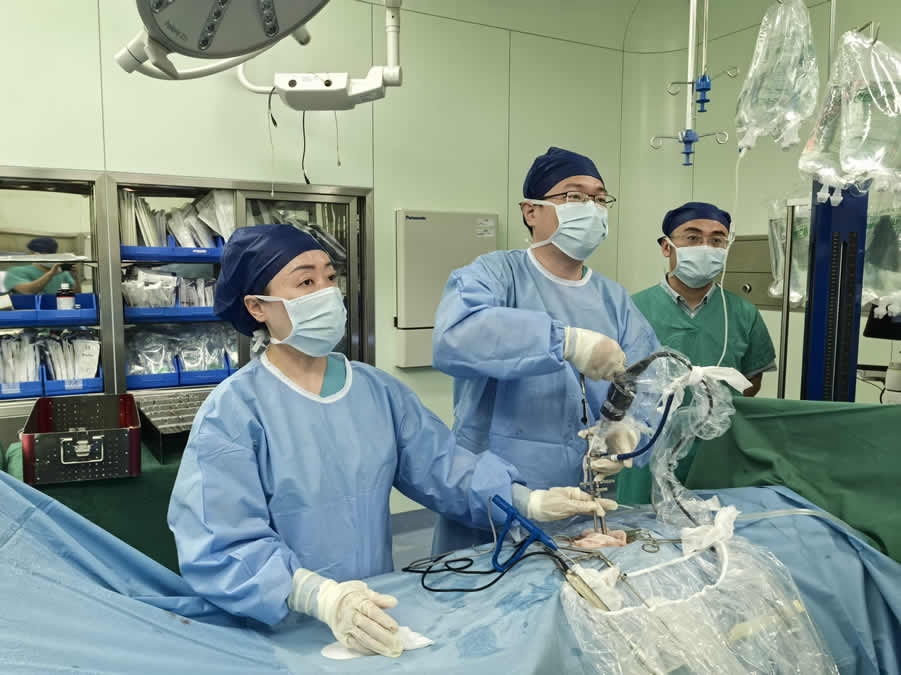
The medical team led by Professor Jia Yifan from the Pain Department of Renmin Hospital of Wuhan University then performed the lumbar endoscopic surgery on Dean Johnson.
Johnson requested to take a new MRI in Wuhan, explaining: "The examination results I brought are three years old, and I am worried that my condition has changed."
When he was told that he could get the scan done no later than the next day, Johnson was astonished: "In the UK, I would have to wait at least one month for an MRI appointment!"
The new MRI results confirmed that the cause of his waist pain was exactly what the medical team had diagnosed. On May 11, Dean Johnson underwent the scheduled surgery.
Right after the surgery on May 11, Dean Johnson expressed his sincere gratitude to the doctors. "Chinese doctors' medical skills are absolutely superb!" he said.
Johnson later described his post-surgery feelings to Professor Jia Yifan (left) and Associate Chief Physician Li Shenghong (right).
Behind Dean Johnson's cross-border medical journey lies the quietly emerging trend of "reverse medical care". According to the report on foreign-related medical services released by the National Health Commission of China, in 2025, key foreign-related hospitals across the country received 1.28 million international patients, marking a 73.6% increase compared to three years ago.
On the social media platform TikTok, the topic "Medical Tourism" has gone viral. Many overseas netizens have left comments saying that Chinese hospitals have now become popular check-in destinations for foreign visitors.
Apart from China's solid medical strength, another key driving force behind this trend is the renowned "Chinese speed" in medical services.
On May 13, American national Davis successfully underwent a fundus surgery at Renmin Hospital of Wuhan University. He said: "In the US, I would have to wait at least half a month for this surgery. Fortunately, a friend suggested I come to China for treatment, otherwise I might have lost my eyesight!"
What shocks foreign patients even more is the affordability of medical treatment in China.
When searching for the keywords "medical tourism China" on social platforms, one can find a large number of detailed photo and text guides. The medical bills shared by overseas bloggers have become the most compelling "recommendation posts" for international audiences.
In China, a routine cardiac examination costs around 75.4 USD. In comparison, in the US, patients without medical insurance have to pay out of pocket between 10,000 and 20,000 USD for the same procedure.
Overseas netizens have commented: "An X-ray in China only costs 19 USD, which is even cheaper than a doctor simulation toy you can buy in an American supermarket."
Reporters found that the "new three treasures" of China travel that foreign bloggers are showing off have shifted from mobile payment, high-speed trains and hotel service robots to "dental check-ups, eye examinations and traditional Chinese medicine physiotherapy".
Many foreign tourists will go for a teeth cleaning after visiting scenic spots. If a cavity is found, they can get it filled on the spot for only around 20 USD. Some will take an eye examination and get a new pair of glasses made to bring back home. Many others have fallen in love with traditional Chinese medicine physiotherapy, finding treatments like moxibustion, acupuncture, pulse diagnosis and steam therapy both novel and effective.
Wuhan has now become a popular city for medical tourism. Earlier this year, the city put forward the initiative to build itself into an international medical innovation highland.
At the Yangchunhu Campus of Wuhan Central Hospital, the international outpatient department has entered the trial operation phase. The international medical zone at the Chegu Campus of Wuhan Union Hospital has already been put into use. The hospital has established a multi-level international commercial insurance payment system, enabling direct settlement for international patients with their insurance plans.
Many people have raised the concern: will the large number of foreign patients coming to China for medical treatment affect the access to medical services for local Chinese patients?
Leaders of multiple hospitals in Wuhan told reporters that currently, the impact of foreign patients on local residents' medical treatment is negligible. Doctors will prioritize completing the basic medical services for local patients before attending to international patients. In addition, foreign patients treated in the international medical departments pay via commercial insurance or out of pocket, which does not consume China's domestic medical insurance funds.
The wave of reverse medical care has arrived. One day, "Chinese medical services" will win worldwide recognition just like "Made in China" products. Reporter: Wang Kaining from Changjiang Daily, Correspondent: Liu Yu
Reprinted from People's Daily
Disclaimer: The information in this article is for general science popularization reference only and shall not be construed as medical diagnosis suggestions.
.png)
.png)