تفاصيل القسم
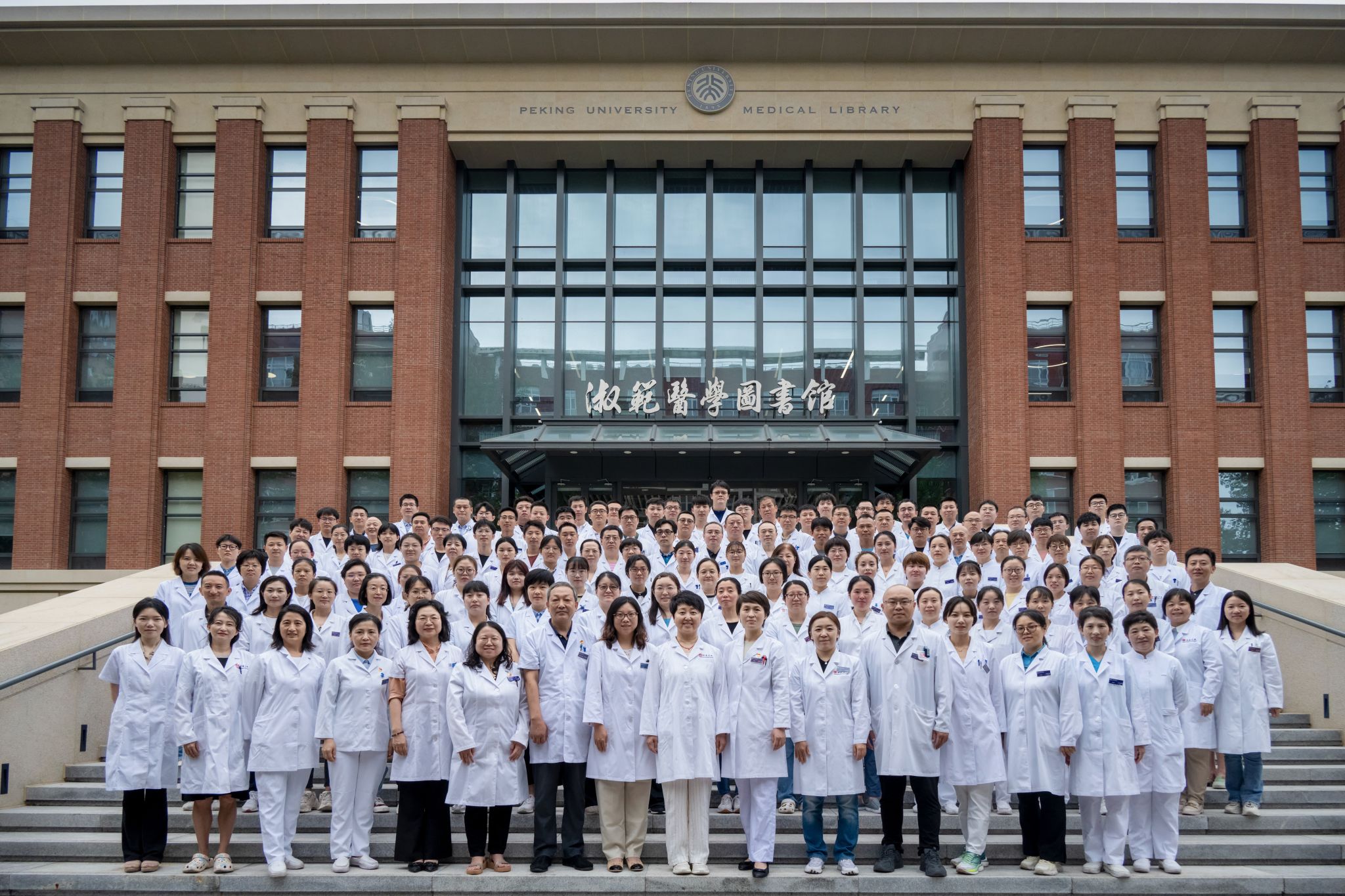
The Department of Radiology at Peking University Third Hospital was founded in 1958, at the inception of the hospital, and was established by Professor Li Guozhen. After more than sixty years of development, under the successive leadership of five department directors—Professor Li Guozhen, Professor Liu Gengnian, Professor Xie Jingxia, Professor Li Xuan, and Professor Yuan Huishu—the department has evolved into a modern medical imaging department characterized by comprehensive service categories, advanced equipment, and coordinated development of clinical service, education, research, and disciplinary construction.
Currently, the department has 198 staff members on duty, including 52 in the diagnostic group, 113 in the technical group, 12 in the nursing group, 17 in the registration group, and 4 in the engineering and secretarial group. Among them, 10 hold senior professional titles and 15 hold associate senior professional titles. Over 90% of diagnostic physicians hold doctoral degrees, and 7 technologists hold master's degrees.
In terms of departmental hardware, the main campus of Peking University Third Hospital and its branch campuses currently possess 14 high-field MRI systems of 1.5T or above, 14 high-end CT systems with 64-slice or above configuration, 1 full-field digital mammography system, and 22 digital radiography (DR) systems. A PACS and RIS platform covering the entire hospital and all branch campuses has been established, enabling informatized and digitalized imaging management, as well as self-service retrieval of diagnostic reports and imaging films. Under the hospital's group-based development strategy, imaging equipment at various branch campuses is being progressively updated and configured.
Leveraging the advanced equipment platform, the department provides comprehensive digital radiography, computed tomography (CT), magnetic resonance imaging (MRI), and various interventional diagnostic and therapeutic services. Over the past decade, the annual examination volume has grown steadily, with over 960,000 patients receiving imaging diagnostic and interventional therapeutic services in 2022. The department holds a leading position domestically in the clinical application of multi-slice spiral CT and high-field MRI, capable of performing routine CT and MR examinations across all body systems, as well as complex examinations such as neonatal and fetal brain MRI and MR arthrography, fully meeting clinical requirements for imaging examinations of various diseases. The department places great emphasis on medical quality and safety, continuously optimizing clinical workflows and refining examination protocols. In 2014, a quality control (QC) module was integrated into the RIS platform, enabling quality assessment across all stages of the process, from registration, examination, and diagnosis to result delivery. Additionally, the department values multidisciplinary collaboration and communication, conducting multidisciplinary team (MDT) comprehensive diagnostic discussions and joint imaging reading sessions with multiple hospital departments, including pain and tumor CT interventional outpatient services, combined respiratory outpatient clinics, and combined neurology outpatient clinics. In response to patient needs, the department added radiology outpatient consultation services in 2019, substantially addressing the demands of patients and clinicians for consultation on complex imaging cases and on-site imaging interpretation.
The Department of Radiology at Peking University Third Hospital is one of the first institutions in China authorized to confer master's and doctoral degrees in imaging. To date, it has trained nearly 200 doctoral and master's graduates, with numerous doctoral and master's students currently enrolled. The department has long been responsible for teaching the Imaging Medicine and Nuclear Medicine curriculum at Peking University Health Science Center, training dozens of visiting physicians and scholars annually. In 2007, it became one of the first standardized residency training bases in Beijing, and in 2016, it ranked first in the Beijing residency training base inspection. Since 2012, the department has continuously hosted annual national advanced comprehensive imaging diagnostic forums and advanced musculoskeletal imaging training programs, as well as organizing multiple national and Beijing-level continuing education courses, greatly enhancing the department's academic influence.
In 2011, the department was designated as the Beijing Key Laboratory of Magnetic Resonance Imaging Equipment and Technology. It has undertaken nearly one hundred research projects, including the National Key Technology Research and Development Program of the 12th Five-Year Plan, the National Science Fund for Distinguished Young Scholars, the National Natural Science Foundation of China, National Key Research and Development Program projects, the National 863 Program of the Ministry of Science and Technology, the National 985 Program of the Ministry of Science and Technology, the China Postdoctoral Science Foundation, the Beijing Capital Medical Development Research Fund, the Beijing Natural Science Foundation, the Beijing Municipal Science and Technology Commission Capital Clinical Characteristic Application Research, and the Beijing Science and Technology Leading Talent Training Program. The department has repeatedly received major awards, including the Ministry of Education Science and Technology Progress Award and the Chinese Medical Association Award, as well as multiple research patents. Over 780 academic papers have been published in domestic and international core journals, including more than 150 papers indexed in SCI and EI, along with numerous monographs and translated works. More than one hundred person-times have participated in and delivered presentations at top international and domestic conferences, including the Radiological Society of North America (RSNA), the European Congress of Radiology (ECR), the International Society for Magnetic Resonance in Medicine (ISMRM), and the annual national conference of the Chinese Society of Radiology of the Chinese Medical Association.
Several experts from the Department of Radiology at Peking University Third Hospital hold key academic positions domestically. Professor Yuan Huishu, Administrative Director of the department and disciplinary leader, serves as a Standing Committee Member of the Chinese Society of Radiology of the Chinese Medical Association, Chair of the Musculoskeletal Professional Committee, Vice Chair of the Beijing Medical Association Radiology Branch, and Standing Director of the Beijing Physicians Association Radiology Specialty Branch. She is an editorial board member of multiple core journals, including the *Chinese Journal of Radiology* and the *Chinese Journal of Medical Imaging Technology*, and serves as the Section Editor for the Musculoskeletal Radiology section of the *Journal of Clinical Radiology*. She has twice received the Second Prize of the Ministry of Education Science and Technology Progress Award.
Professor Han Hongbin currently serves as Dean of the Institute of Medical Technology at Peking University Health Science Center, Chair of the Magnetic Resonance Equipment and Technology Professional Committee of the China Association of Medical Equipment, member of the National Industrial Foundation Expert Committee, Director of the Key Laboratory of Medical Imaging Equipment Quality Control of the National Medical Products Administration, and Corresponding Academician of the Life Sciences Division of the International Academy of Astronautics. He has received numerous national and provincial-level scientific research achievements, including the National Science Fund for Distinguished Young Scholars and the China Youth Science and Technology Award, and has filed multiple patents.
Professor Liu Jianyu serves as a member of the Abdominal Professional Committee of the Chinese Society of Radiology, a council member of the China Imaging Technology Research Association and a member of its Radiology Branch, and serves as an invited reviewer and review expert for multiple journals, including the *Chinese Journal of Radiology* and the *Chinese Medical Journal (English Edition)*. Several other physicians in the department also hold important positions in major academic organizations nationwide.
In terms of disciplinary development, Professor Yuan Huishu has led the department in deepening reforms by implementing subspecialty grouping for imaging diagnosis, resulting in a more complete and rational disciplinary structure. The department currently comprises five subspecialty groups: the Musculoskeletal and Joint Group, the Gastroenterology and Urology Group, the Cardiothoracic and Vascular Group, the Neurology and ENT-Ophthalmology Group, and the Interventional Group. All diagnostic subspecialty groups advance in parallel, with the Musculoskeletal and Joint Group, leveraging the hospital's advantageous clinical platforms, continuously accumulating experience and innovation, achieving an absolutely leading position in the field of musculoskeletal imaging domestically.

 العربية